 |
| Important Links |
|
|
|
|
 |
 Value added Quality Protein Maize (QPM) products Value added Quality Protein Maize (QPM) products |
 |
 |
|
| Background |
Maize is a major cereal crop for both human and livestock nutrition, worldwide. With its high content of carbohydrates, fats, proteins and some of important vitamins and minerals, maize acquired a well deserved reputation as a poor man’s nutria-cereal. Several million people, particularly in the developing countries, derive their protein and calorie requirements from maize. Animal protein, of course being of higher quality, is scarce and expensive, thereby unavailable to a vast sector of the population. Therefore, this vast segment (human population) depends upon cereals for their nutrition and livelihood. Protein from cereals including normal maize, have poor nutritional value because of reduced content of essential amino-acids such as lysine and tryptophan leading to harmful consequences such as growth retardation, protein energy mal-nutrition, anemia, pellagra, free radical damage etc. As a consequence, the use of maize as food is decreasing day by day among health conscious people.
The complex nature of these problems posed a formidable challenge before the agricultural scientists whose research priority always remain enhancement of the nutritional status of crops.
This challenge was gladly accepted by two distinguished scientists of CIMMYT, Mexico, Dr. S. K. Vasal and Dr. Evangelina Villegas whose painstaking efforts for a period of 3 decades led to development of Quality Protein Maize (QPM) with hard kernel, good taste and other consumer favouring characteristics. This work is globally recognized as a step towards nutritional security for the poor. Dr. Vasal and Dr. Evangelina Villegas were awarded world food prize for their path breaking research in this direction.
QPM research and development efforts appropriately spread from Mexico to Central and South America, Africa, Europe and Asia. India also benefited with such germplasm and developed its first QPM composite variety ‘Shakti–1’ released in 1997 for commercial cultivation across the country.
In 1998, the Rajendra Agricultural University (RAU) stepped ahead with further R & D towards the development of QPM variety and popularization of QPM as food. Research priorities were fixed by the university both for varietals development and product development through the process of value addition by way of value chain management. The breeding programme on QPM was focused at AICRP Centre on Maize located at Tirhut College of Agriculture, Dholi (MUzaffarpur) whereas value addition activities were carried out at the Department of Food and Nutrition, College of Home Science, Pusa.
As of today, RAU has marched ahead in both areas and has its own success story upon QPM. A production-consumption chain has been established only with QPM and the products developed by the university are being manufactured and marketed by various enterprises putting a win to win situation for every stakeholder whether a scientist, a seed grower, a cultivator, a manufacturer, a marketing personnel or the consumers.
The story with different activities is being enumerated below for motivation to others. |
| Quality Protein Maize |
It is an improved variety of maize which contains higher amount of lysine and tryptophan with lower amount of leucine and isoleucine in the endosperm than those contained in normal maize. Such balanced combination of amino acids in the endosperm results into its higher biological value ensuring more availability of protein to human and animal than normal maize or even all cereals and pulses. |
| QPM breeding programme by Rajendra Agricultural University, Pusa |
A continuous efforts of plant breeder Dr. P. B. Jha yielded into the development of first hybrid variety of QPM in India in the year 1999-2000 as Shaktiman 1. Later on Shaktiman 2, Shaktiman 3 and Shaktiman 4 were developed with higher productivity. The kernel of Shaktiman 1 and 2 is white whereas that of Shaktiman 3 and 4 is yellow. |
| Productivity status of QPM varieties |
| S.No. |
Variety |
Colour of grain |
Productivity (q/ha) |
| 1. |
Shaktiman – 1 |
White |
50-55 |
| 2. |
Shaktiman – 2 |
White |
55-60 |
| 3. |
Shaktiman – 3 |
Yellow |
70-75 |
| 4. |
Shaktiman –4 |
Yellow |
75-80 |
|
| Nutritional impact of QPM on human and animal |
| As Food |
Impact on children: QPM feeding of preschool children continuously for six months showed a significant increase in weight and arm circumference with marginal increase in height. Increase in Intelligence Quotient (I.Q.) amongst children due to QPM feeding is also a reported fact.
Impact on pregnant women: Feeding of QPM to pregnant women continuously for six months starting from the end of 1st
Impact on old age people: Use of QPM as food by old age people proved beneficial by providing them relief from gastric and other indigestion ailments. trimester upto last trimester showed significant impact upon the health of the babies and mothers.
As Feed
Impact on animals: QPM feeding to pigs and chicks resulted into fast growth in their bodies. A significant increase in milk production has been reported when QPM is fed to cows and buffaloes. |
| QPM as food : Agricultural aspects |
Quality Protein Maize grains due to higher productivity, higher content of protein as well as its higher biological value can be better option as food over other cereals like rice and wheat. In Bihar, where the productivity of QPM is much higher than that of rice and wheat and at par with other normal hybrid maize, it can be the best option for ensuring food and nutritional security virtually at no additional cost. |
| Commercialization of QPM added products |
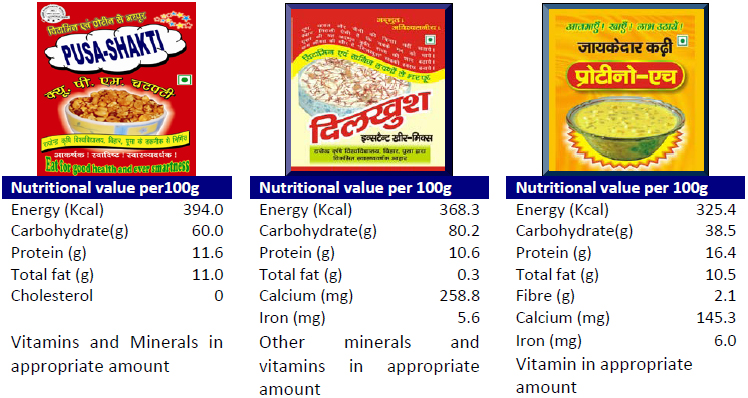
A tremendous enthusiasm and continuous effort with hard labour and zeal by two scientists, Dr. Usha Singh, University Professor, Department of Food and Nutrition, College of Home Science, RAU Pusa and Er. Subhash Chandra, Assistant Professor, Department of Farm Machinery, College of Agricultural Engineering, RAU Pusa helped in conversion of the ideas behind commercialization of QPM based products into realities. The commercial production of Pusa-Shakti (QPM Chatpati) has been started by an enterprise named M/S Om Shakti Foods located at Sujawalpur (Dholi) of Muzaffarpur district. The other two products named Dilkhush (instant kheer-mix) and Proteino-H (kadhi-mix) was launched in the market for sale in the month of June, 2009. Dilkhush (Kheer-mix) and Proteino-H (Khadi-mix) are being produced by M/s Guru Kripa Foods, Ramdayalunagar, Muzaffarpur and M/s Pragati Swawlambi Sahkari Samitee, Dholi, Sakara, Muzaffarpur, respectively.
Marketing of all above products is being done through a marketing wing in 9 (nine) districts of the state including the capital Patna. Pusa-Shakti has become the exclusive choice of the people. As per direction of the state government, Pusa-Shakti is being supplied as snacks in the meeting of the cabinet of ministers of Bihar regularly. Dilkhush (Kheer-mix) is greatly demanded by the people of higher income group especially in towns and cities. In comparison to Pusa-Shakti and Dilkhush, market demand of Proteino-H is lower because of food habit of the people of Bihar who generally like Kadhi as occasional food.
The increasing demand of all the products has opened a gateway for agricultural and industrial growth besides generation of employment opportunities among the youth. Many other products from QPM are under process of screening on the basis of nutritive value, organoleptic quality as well as marketing potential. |
| Characteristics of commercialized QPM based food products |
| Sl.No. |
Product Name |
Ingredients |
Special features |
| 1. |
Pusa-Shakti |
Rice, bengal gram, groundnut, QPM, and salt & spices, nutritional supplements etc. |
• Roasted product with zero trans fat
• MSG free and Fibre rich
• Cholesterol free and Enriched with Vit. A & E
• Contains protein of higher biological value |
| 2. |
Dilkhush |
Milk, sugar, QPM, rice, raisins,dates, sago, nutritional supplements etc. |
• Low calorie kheer with higher amount of calcium/100gm
• Tasty, aromatic and nutritious with Lower fat content
• Lower cooking time (18-20 min.). Nothing except recommended amount of water to be added. |
| 3. |
Proteino-H |
QPM, milk, spices, pulses, salt, sago, nutritional supplements etc. |
• Low cost product with good taste & attractive colour
• Contains higher percentage of nutrients specially protein, vitamins & minerals
• Good aroma and lower cooking time (5 min.)
• Nothing to be added except recommended amount of water |
|
| Nutritious status of commercialized food products |
 |
Products under commercialization process
1. Health – mix : Quality test by CFTRI, Mysore
2. Honey based drink
3. Honey QPM toffee
4. Khichadi – mix : Quality test by CFTRI, Mysore
5. Halwa – mix
Cascading effect of commercialization of value added QPM based food products
The demand of QPM based food products in the market has helped in creating production-consumption chain management for QPM. The system has generated lot of benefits to the stakeholders like QPM seed grower, cultivators, entrepreneurs, consumers and youth. The impact of commercialization of value added QPM based food products can easily be realized through gross evaluation of the system. Some of the benefits of production-consumption chain management, as a part of the success story is mentioned below : |
Benefits :
1. Increased participation of QPM seed growers
2. Increased cultivation of QPM grains
3. Set-up of small scale industry in rural sector
4. Employment of women under production unit
5. Employment of youth under marketing division
6. Nutritional security to the consumers
7. Food security due to increased consumption of maize as food
8. Higher return to farmers due to higher yield of QPM of over other cereals and 15-20% incentive price for QPM as compare to normal maize
9. Motivation to colleague scientists for translation of their generated proven technology
10. Introduction of marketing concept in agriculture
11. Orientation of institutional activities towards people’s benefit oriented research
The commercialization of QPM based food products is the output of FEIP (Farmer, Entrepreneur, Institution and People) chain, a revolutionary though generated by the scientists associated with this programme. The whole programme is running successfully under the patronage of the Hon’ble Vice-chancellor. The support rendered by the scientists of AICRP on Maize under the leadership of Director Research has been the key to the success and it is expected that this success story of QPM will pave the path for other success stories in different wings of agricultural science.
For more information contact:
Dr Usha Singh
University Professor
Department of Food & Nutrition
College of Home Science
Rajendra Agricultural University
Pusa (Samastipur) 848125 India
or
Er. Subhash Chandra
Assistant Professor
Department of Farm Machinery
College of Agricultural Engineering
Rajendra Agricultural University
Pusa (Samastipur) 848125 India |
|
|
|